

How to Stop Writing Immediately
For the professional writer intent on self-sabotage, we must return to the perfect poison.

Prep:
Hike a haiku
Geistzeit Playfulness v. Manipulation
Horrify your Ego
Cartoon your sense of self
Jackrabbit onto the 29th Street sidewalk
Attract your favorite interruptions
Rumble into your elephant’s stride
Get bone-chilling honest between your hemispheres
Unzip your .scriv gift
Ship your 170 gsm, 298 page Admit One
As you read between the lines of the essay here, keep in mind:
Any interruption automatically induces an 18-minute transition from the moment the crisis is solved to a resumed state of play & plotting
Meanwhile — during the crisis — you aren’t writing!
Winter dull drums still
problems now scream solutions
war returns clever
Interruptions come from:
1. Other people trying to get your attention
2. Other people disrupting your flow because you tricked them
3. Worrying
We’ll dice through these types of interrupts in a moment.

When you get into a flow state, Iterate
Playfulness. Put simply, trying things.
During play, vague, troubling ideas bubble up. These are completely natural!
The part of you which is playful can generate an infinite supply of ideas, motive, narrative, dialogue, clever aha’s, and strange pivots.
Enjoy the playfulness!
As the ideas pour forth onto your writing surface, you may feel overwhelmed — here is a signal from your plotting facet to take a turn.
Manipulation. Just as simply, attempts at controlling the story.
During plotting, drop back a few hundred words, perhaps a few thousand, and read forward. The technique is called cycling.
Witness the fun storytelling as if you were your most ardent Reader.
Clarify sentences
Swap the order of paragraphs
Correct typos (Note: typos are playfulness!)
Presently, your plotting facet will have caught up to where your playfulness paused — here is a signal from your playfulness facet to surge forward using the energy of your first Reader’s reactions!
You are your first Reader!
But sidestep the temptation to control the stakes of storytelling. The human Animal evolved; the deeply rooted fight | freeze | flee instinct for survival was what the Ego attached to when individual identity surfaced in human development — not so many hundreds of years ago!
Nowadays, we fight about how others perceive us; or we freeze, or flee.
But it’s just our current sense of identity which is at stake.
The better you become with your writing Craft, the more frequently you change who you are; writing changes the writer.
Why?
Fictional Thought
Unlike academic thinking; scientific thinking; critical thinking; and unlike problem solving based on logic, Fictional Thought is a mode of processing experiences — a mode which:
Reimagines what just happened — or what happened Once Upon a Time in a Galaxy Far, Far Off-Site
Great writing involves all the senses — smell, taste, visual cues, touch, heard sounds, the sense of balance, changes in heat, the kinesthesia which track the position and motion of one’s body parts, and the swirl of feelings experienced in the organs; in advanced writing, the storytelling can become cross-modal synesthesia and suddenly blue smells like strawberry flowers and the buzz you thought were bees is a hive of hummingbirds who harvested spider webs which taste like lemon grass steeped in rose buds to build their fluffy condominium on the ridge where raspberry thorns scraped a pair of talon lines on your right arm with a dribbly feeling of blood and a carpet burn aftertaste.
Intuition and fervent belief cloud the problem statement with unusual insights and ridiculous ignorance
Rational Thought goes head-to-head with a Pen Dragon speaking in forked tongues of Jabber Which Is Wocky
Musical passages add color and thin walls to transparency
During the bridges, flights of fancy drop coconut shell halves into your hands for a spontaneous bare horseback ride
Physicality draws imagery out of muscle memory
In short, in long, Fictional Thought shifts your point of view in the storytelling.
You aren’t who you thought you were!
Not any longer!
Naturally, the Ego freaks out. However, our reactions are limited to:
1) Pick a fight
2) Sidle into the shadows and go still and hope you dressed in dark colors
3) Flee the scene! Put the book down! Chatter nervously!
Another curious thing will happen: your Ego will adapt.
For example, when playful me created Admit One - Professional Writer.scriv, the Inner Team cycled through the .scriv project multiple times:
Created, then fleshed out the essays
Created, then organized custom icons
Created, then spell-checked the Now Write Into the Dark teasers (so you wouldn’t face a blank page!)
The Playfulness part of the Inner Team was having fun!
The Manipulative part of the Inner Team was feeling heard!
Then I found out how many people bought perpetual licenses to Scrivener — in a long string of zeros with several commas!
My Ego freaked out! You see, I had never before considered myself to be an indie Author influencer.
Worse, I immediately and abruptly faced early childhood fears:
Messaging by “family” at the time, which attempted to condition me against leaving them by succeeding
Similar messaging which told me they would never fund college because, well, that would mean I would leave their mostly ignorant, poverty-based lifestyle
What was the core fear?
My Ego was terrified of any identity which runs counter to those early life narratives.
The dark humor: I didn’t write those narratives!
Now I’m a storyteller.
A professional writer.
Arguably the lowest-paid career anyone could ever choose!
You’d think: Hah! He’s finally living down to his previous family’s training and expectations.
But guess what?
I’m getting amazing at storytelling!
Every time I lift pen, click keys, cycle play & plotting, I’m redefining who I am. Fictional Thought reframes our Ego with fresh storytelling.
It’s not the stories your early life influencers laid on you!
What happens instead?
Your Ego gets to run alongside and — as the chasm under the next railroad bridge looms closer — the Ego chooses to flee apparent certain death of identity and jumps onto the train car’s step, just as the bridge abutment cuts off the alternate, previous self-identity.
You’ll feel the breezes swirling with river smells from the drop below; witness the blurring of steel trusses reflecting the sound of steel wheels on iron rails clackity-clack. From inside the passenger car the scream of some woman’s baby makes your skin bumply and the nape hair rise.
Fictional Thought is dependably more powerful than other forms of thought. As your writing Craft strengthens, more facets get involved.
And by the time you’ve written 28 books, every part of the Inner Team is engaged in world-class storytelling.
Welcome to 29th Street
29th Street Writing: where every avenue intersecting 29th Street is a novel completed on your pub crawl.
How close to freeze, fight, or flee is your Ego just now?
Bet you’ve never so quickly shifted perspective on your writing!
Now, we’ve touched on how your professional writing changes who you are.
We’ve clarified cycling in iterative writing.
Whatever your current definition of success is, soon you will not be who you once thought you were.
Let’s move on to the three modes of interruption — keep in mind, these are your last opportunities to avoid becoming a successful professional writer!
Let’s take the third interruption bucket first
Why?
Worry is an internal tussle.
3. Worrying
The Critical Voice has a job to do: keep you safe. Safety first is a component of identity, which evolved in human Animals the moment self-awareness surfaced. It’s the same self-awareness we see in young human Animals as they transition from screaming for food into plotting how to manipulate others into bringing the next delicious treat.
The plotting turns into play. How unusual is it for an offspring to wear out a parent with relentless play, wheedling; pushing boundaries; mimicking moves parents and other adults use to influence each other.
So we have play and plotting working together now.
For the professional writer, the exact pair, when working together, which make us better writers.
When playfulness and plotting disagree about a sentence — or even what to do with a blank page chapter start — we worry ourselves.

Stop Worrying
Give yourself room:
A writing tool dedicated to professional writing. Put nothing else on the tool! Regardless of which sensory mode connects with the writing tool first, the Inner Team must know it’s play & plotting time. Fingertips touch; the ears hear a click of key or scritch of pen; the nose discerns paper, pencil, ink, coffee, or tea; the eyes rove across the tool and writing surface; these are cross-modal corroborations play & plotting have begun! Shove the selves-harrying worry aside.
A workstation. Select a desk, table, or coffee shop high bar spot where your play & plotting team can become a regular.
In real estate and customer-facing circles, the mantra is “Location! Location! Location!” Your primary and secondary play & plotting location is the hill or play aerie, which you deeply feel is worth defending.
If your aerie has a door, use the door as a message to others: play & plotting is underway.
Sessions. Fortified with tool & workstation, we turn our attention to time.
Time & timing are trade secrets of the professional writer.
Unlike rote tasks, such as one finds in customer service (answering phones and emails), IT (attending meetings most of the day and taking enough notes to seem intelligent at the next meeting), vehicle maintenance (draining oil, swapping in a new filter, refilling the engine with fresh oil), play & plotting require deeper forays into time.
One can execute rote tasks using a Pomodoro strategy of 25-minute periods of “work” interspersed with 5-minute breaks. Twenty-five minutes of focus on a rote task or sequence of task steps is about all the average Ego can tolerate.
For the corporate lifestyle, the numbers make sense:
25 minutes’ work + 5-minute break + 25 minutes’ work + 5 minutes = 60 minutes.50 minutes of work divided by 60 minutes per hour = 83% efficiency.An axiom in the corporate lifestyle is the 80 / 20 rule: 83% is a 3% boost in productivity!For play & plotting a 25-minute work pace interspersed by 5-minute breaks guarantees you’ll interrupt yourself 17% of the time you have available.

Golden Nugget: 90-minute Sessions
There are many studies whose results corroborate creativity improves when play & plotting have 90 minute periods of sacred sessions.
I’ve been using Geoff Hackworth’s $3.99 perpetual license Pommie app with the following settings:
Work Length: 1 hour, 30 minutes
Short Break Length: 7 minutes
Long Break Length: 1 hour, 30 minutes
Work Periods Per Round: 1
Pommie’s behavior with the settings:
90-minute “work” timer
90-minute “break” timer
The 7-minute short break is skipped entirely
…and I’ve noticed something interesting: I get into a 90-minute groove!
90 minutes of play & plotting
90 minutes of anything else
Ninety minutes of anything else practically guarantees you’ll live in reality long enough to feel grounded. Your boredom level will rise. With a perked ear, you’ll listen for the switchover of your Pomodoro timer for the next 90 minutes of play & plotting!
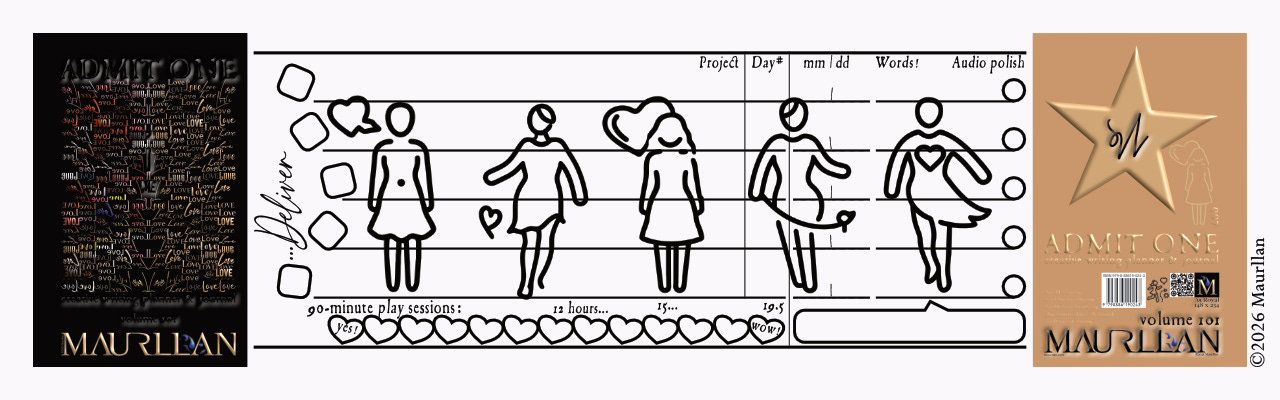
Get in the 90-minute Groove
I’ll admit to feeling excited by an unexpected insight: there’s an elephant’s stride to alternating 90-minute sessions between reality and play & plotting.
It’s like a slow walking bass line.
As I write the essay here, I’m cautiously exploring the idea of switching my nocturnal-diurnal pattern from a 60-minute corporate lifestyle wage- or salary-tied external messaging drivers, to a 90-minute natural stride.
Since 90-minute strides are natural, we should treat 90-minute sessions with robust respect.
Whether we are in a 90-minute stride of reality or a 90-minute session of play & plotting, an interruption is an interruption.
Happily, disruption is part of reality.
We shouldn’t be surprised by ourselves or those we collect around us when there is a drama moment.
Humans are messy.
Nearing the end of a 90-minute reality beat, you may start feeling desperate to escape to your play & plotting aerie.
Yes, that’s a win!
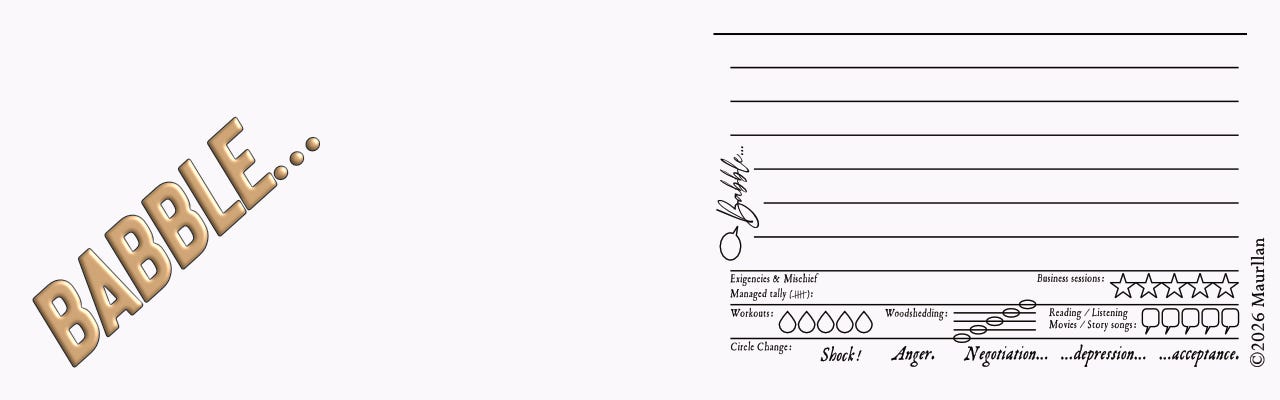
Close the Door
When we escape to a 90-minute play & plotting session, let other people know: close the door.
If your aerie doesn’t have a door, use another signal.
Insert a color-keyed set of earbuds, which subtly clues others to your current mode
Don a pair of mirrored sunglasses
Give your dog away for 90 minutes
Of course you wouldn’t. Your dog thinks she’s you (wag-wag). And you have obligations to reassure her, and those sunglasses and earbuds aren’t fooling her. Meanwhile, your cat has been ignoring you for hours to optimize her next interruption.
Which brings us neatly to:
2. Other people disrupting your flow because you tricked them
Crosschecks:
Have you been clear with your verbal, written signals (hanging a sign on the other side of your closed door; illuminating the red light labeled “ON AIR”), and your non-verbal cues (handing the dog’s leash to your significant other along with a meaningful look)?
Do you reward interruptions from others (taking part in drama; trying to fix “it” in the moment; holding resentments)?
Stare intently into a glass mirror, ensuring you peer first into one pupil, then a moment later gaze intently into the other well of creativity — ask each hemisphere as you stare, “Are you procrastinating?”
The tit-for-tat between humans is often complex. We invite others to disrupt our play & plotting sessions because either play or plotting is reaching out to others to take sides in our internal disputes.
It’s an unfair tactic by either Inner Team member to attempt to gang up on the other Inner Team member by involving external parties.
Rather than baiting someone else to take a side in our own internal disputes, invest a 90-minute session in brainstorming between plotting and play to create mutual internal respect for both modes.
When we sort out our internal discord, suddenly other people leave us alone!
The new mode will take some getting used to.
In your Admit One, circle the “Shock!”

1. Other people trying to get your attention
Well, here we are.
It’s our first 90-minute session where we have:
Hit our elephant stride
Created a better balance between our playfulness and manipulation which better focuses our writing time
Reasons there might be a knock on your closed door:
There’s a fire
Someone at the police department was so amazed by your recent Cozy Mystery they suspect you of writing about an actual crime; there are two officers at the front door with questions, and one of them is a female detective
The puppy peed on the new Persian rug you bought, and your Rebound Boyfriend is scared shitless you’ll blame him!
There may, in fact, be a reality-world situation which interrupts your gorgeous play & plotting session.
Go with the flow!
Save the cat!
Kiss the beau!
You can use the reality event as fodder for an upcoming genre beat.
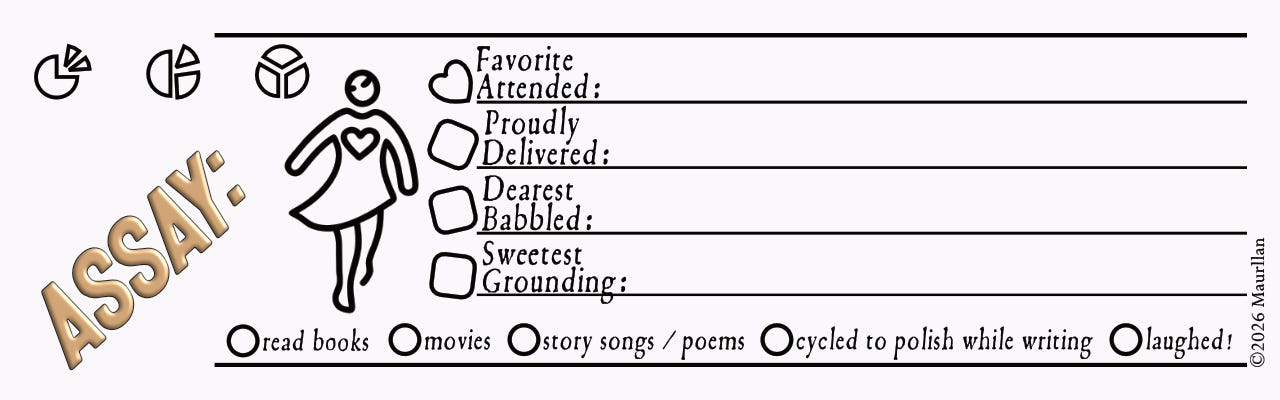
In your Admit One, add a pen stroke to Exigencies & Mischief Managed.
There.
If one or more facets of your Inner Team is still procrastinating, then use the next 90-minute play & plotting session to brainstorm Yet Another Thing From Childhood which is in your way as a professional writer.
You ask me what I think? A cat? Never save the human. Walk out of the fire yourself and people will celebrate.
The question becomes: is your new sense of identity inclusive of 90-minute play & plotting sacred sessions as essential to your professional writing practice?
See you on the pages,
Maurllan.

29th Street Writing
29th Street Writing 90-minute sacred sessions are for storytellers making the deep investment — developing craft, building backlist, and treating storytelling as a career measured in decades, not by a handful of books. Instead of a book or a trilogy, we’re thinking in sets of 29 novels! To help get us there:
Admit One - Professional Writer.scriv is complimentary (free!)
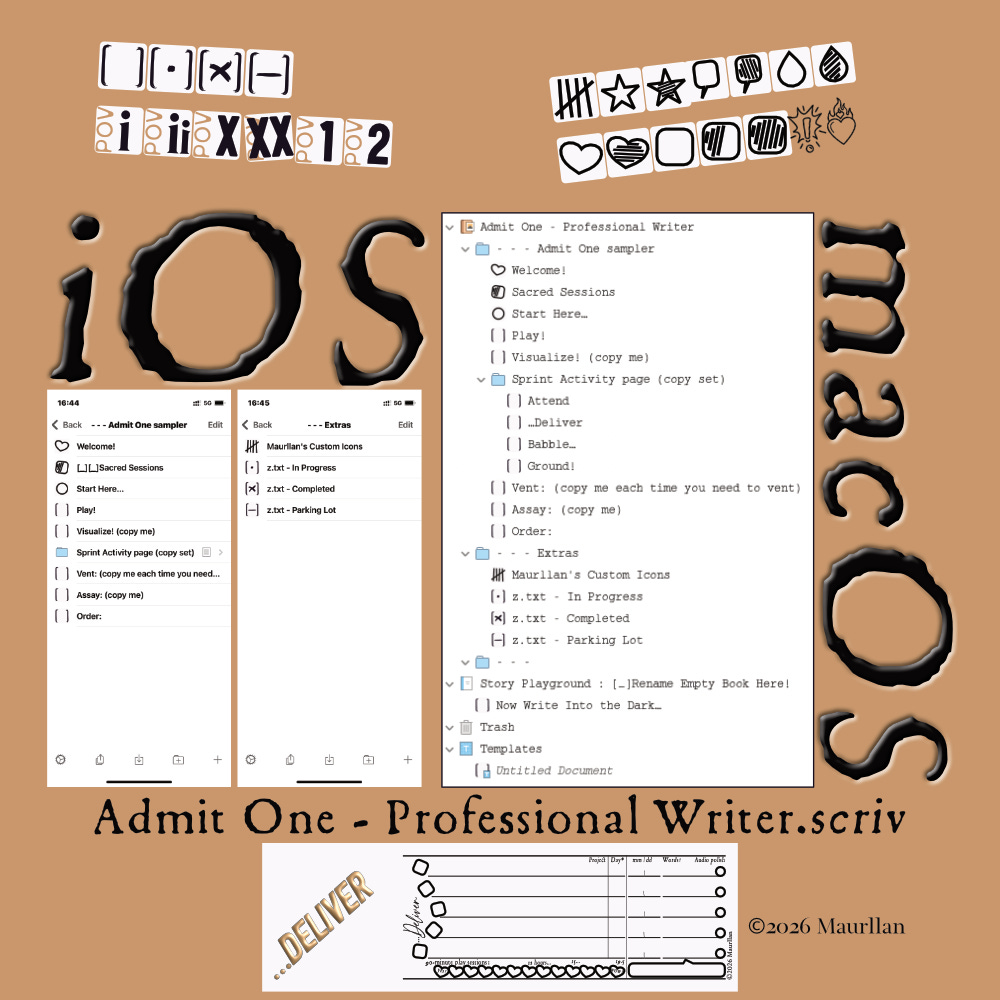
The “Sacred Sessions” document in the Scrivener project template contains this essay, along with sprint tracking tools, plus three sets of custom icons I designed for Scrivener:
36 Session icons!
22 Point of View icons!
7 Project Management icons!
Download your gift:
https://maurllan.com/b/scrivener
Order:
If you want the full analog system as I originally designed my own tool — 170 gsm paper where ink doesn’t bleed plus lay-flat wire-O binding — the physical Admit One: Creative Writing Planner & Journal is only available at Maurllan‘s Cast Theater.
I‘m using my launch edition copy to plan & journal as I write my first 29 novels:
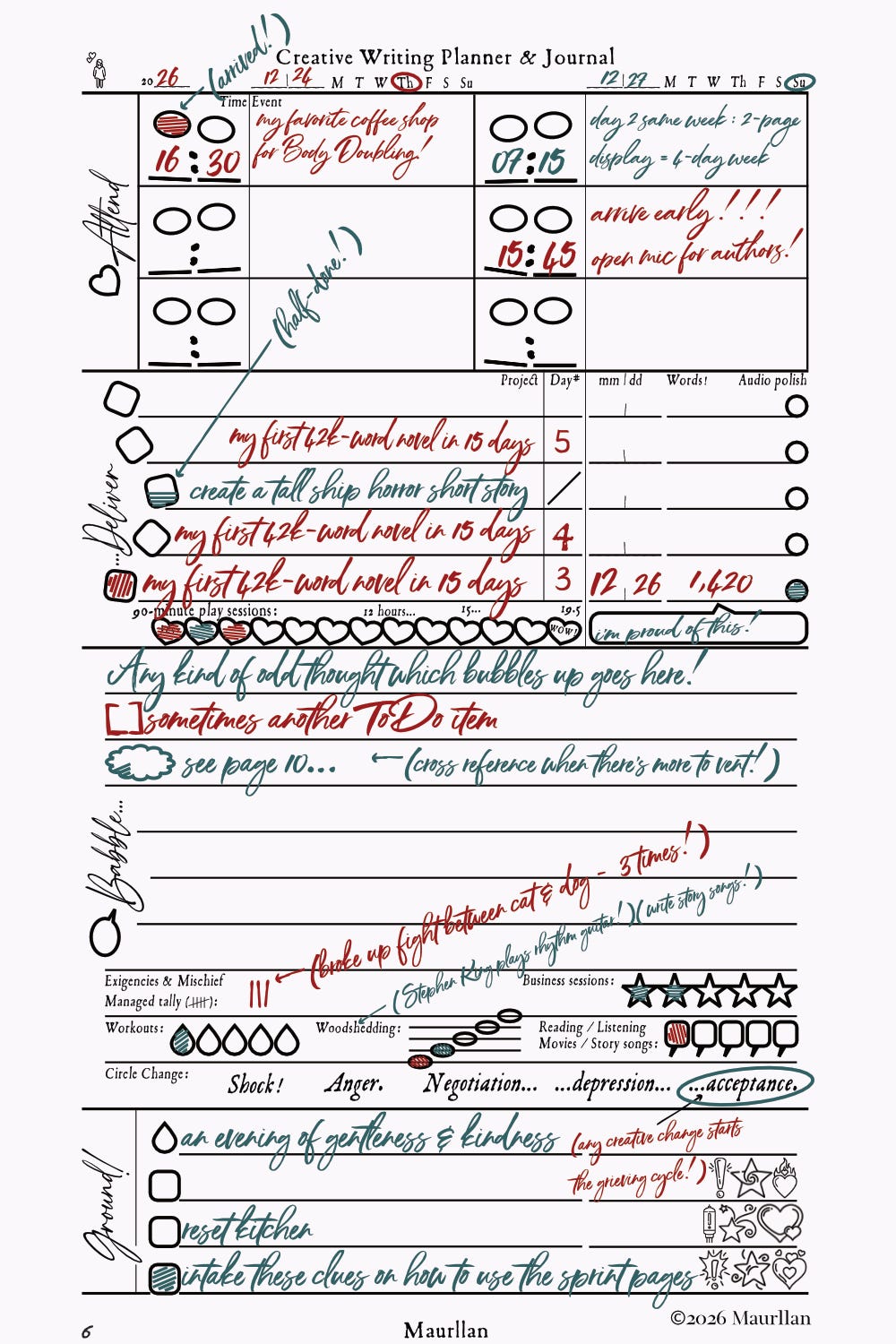

And if something in my essay made your Ego shudder, subscribe so you can tell the tribe in the comments here how your Ego adapted to your newest identity.
For a reusable, playful 90-minute session timer complete with telepathic Body Doubling, see…
Peek first…
Now Playing at MCT
Clever Commuter
Tickle the Pencil
Sprint Pages
Maurllan’s Timepiece
Bookring by Maurllan

Gentleness and kindness succeeding,
Maurllan